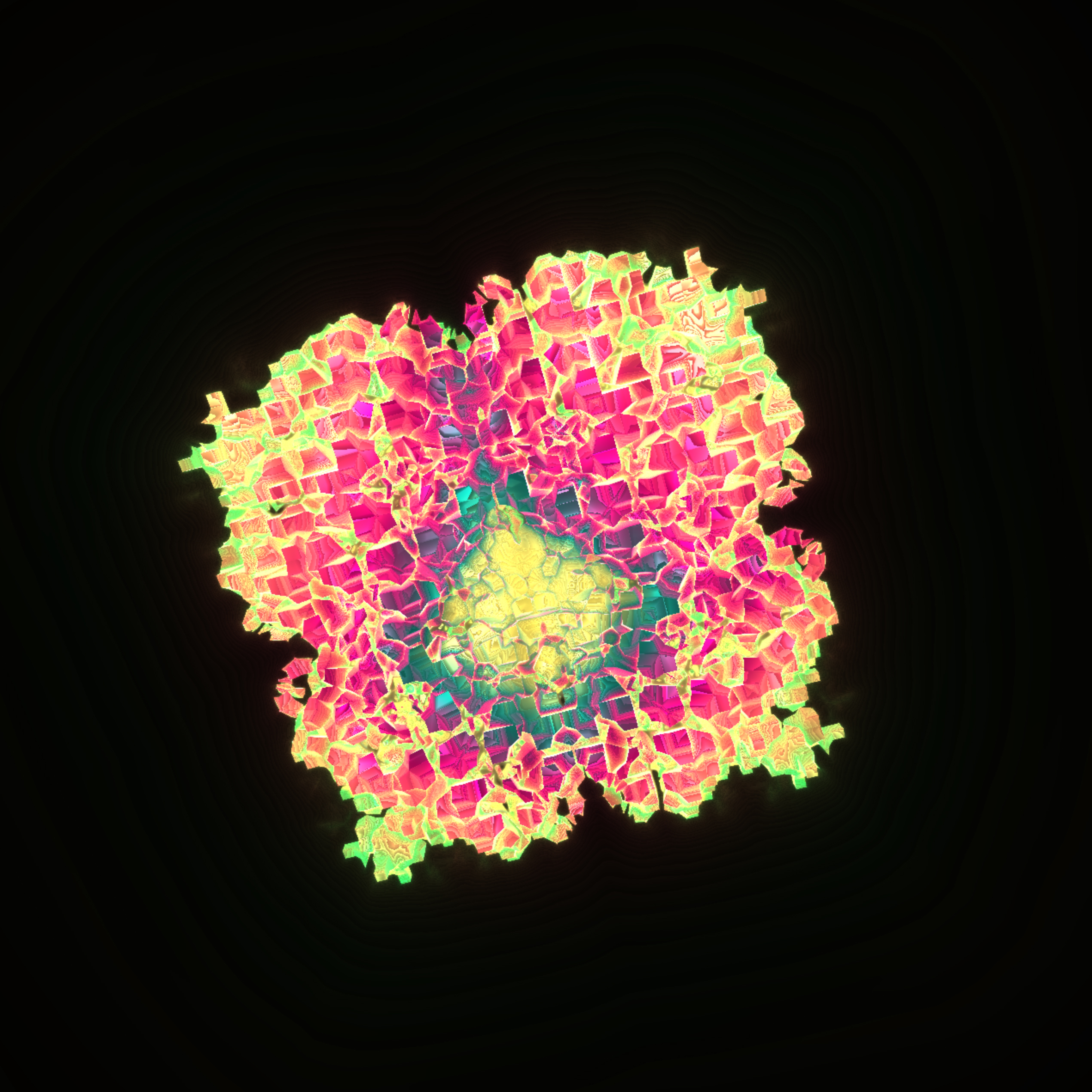
This art piece, "Higgs // Tesseract Field," represents a significant leap from traditional generative art. It moves away from the era of static, random images and into the era of immersive, physics-simulation art.
Traditional generative art (think of the early 2000s) often worked like a plotter: the code would pick a random color, draw a line, pick another location, and draw a circle. It was constructing an image pixel-by-pixel or shape-by-shape.
This piece is different. It does not "draw" anything in the traditional sense. instead, it simulates a volumetric environment.
The GPU as a Camera: The code uses a technique called Raymarching.
Instead of telling the computer where to draw points, the code acts like a radar system. It shoots simulated "rays" from your screen into a mathematical void.
Volumetric Light: When those rays hit the mathematical formula of the object, the code calculates how far the light traveled and how "dense" the fog is. This creates the glowing, neon-gas look. It’s not a flat drawing; it is a 3D environment calculated in real-time.
The visual subject is a Tesseract (a 4D Hypercube) projected into 3D space. Fractal Folding: The intricate details inside the box aren't manually designed. They are the result of an algorithm that "folds" mathematical space. Imagine taking a sheet of paper and folding it in half four times. The code does this to the coordinate system (x,y,z) repeatedly.
4D Rotation: The code applies a rotation matrix not just to x and y (width and height) or z (depth), but to a fourth theoretical dimension w
As the object rotates through this 4th dimension, it appears to turn "inside out" on your screen, which is why the geometry seems to flow through itself.
As the object rotates through this 4th dimension, it appears to turn "inside out" on your screen, which is why the geometry seems to flow through itself.
Most websites play a pre-recorded MP3 file. This piece uses the Web Audio API to generate sound from scratch using mathematics, just like the visuals.
Frequency Modulation (FM): This is the same synthesis method used by the Sega Genesis and 80s synthesizers. One oscillator (the carrier) creates a tone, and a second oscillator (the modulator) vibrates the pitch of the first one extremely fast.
The "Tesseract Frequency": In this piece, the mathematics of the sound are wired to the mathematics of the visuals. When the camera "breathes" in (zooms closer), the FM synthesis index increases, making the bass sound "grittier" and wider. You aren't just hearing a soundtrack; you are hearing the geometry.
The most modern aspect of this piece is how it utilizes Sensor Fusion. It treats the user not as a viewer, but as an input variable in the equation. The "Observer Effect": In quantum physics, the act of observing a particle changes its state. In this art piece, the code requires your input to stabilize.
Gyroscope Integration: By reading the DeviceOrientation (tilt) of your mobile phone, the art breaks the "fourth wall." Tiling your phone physically tilts the 4D mathematical universe inside the screen.
Touch Chaos: When you touch or click, you inject a mathematical value into the Signed Distance Function (SDF) - based on your device's capabilities and functionality. This value disrupts the clean geometry, adding a sine-wave distortion to the field—visually representing "instability" or high energy.
This is essentially an "interactive shader." It is an evolution of generative art because it doesn't just produce a result; it creates a living feedback loop. The math generates the world, the sensors read your physical movements to warp that world, and the audio engine translates those warps into sound frequencies, creating a unified, multi-sensory experience for synesthetes and non-synesthetes alike.
༒