The postcard arrived on a Tuesday, though I cannot say who sent it.
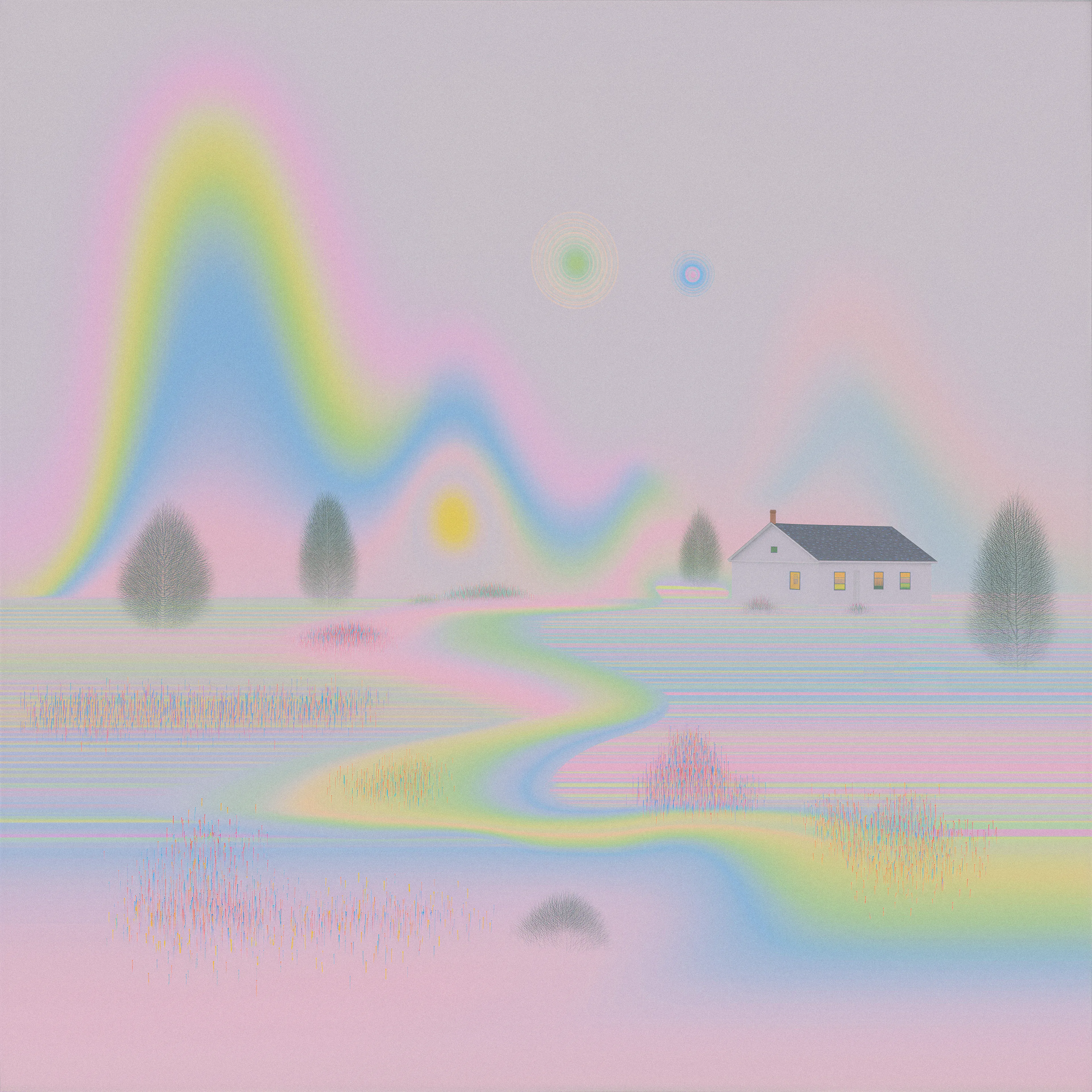
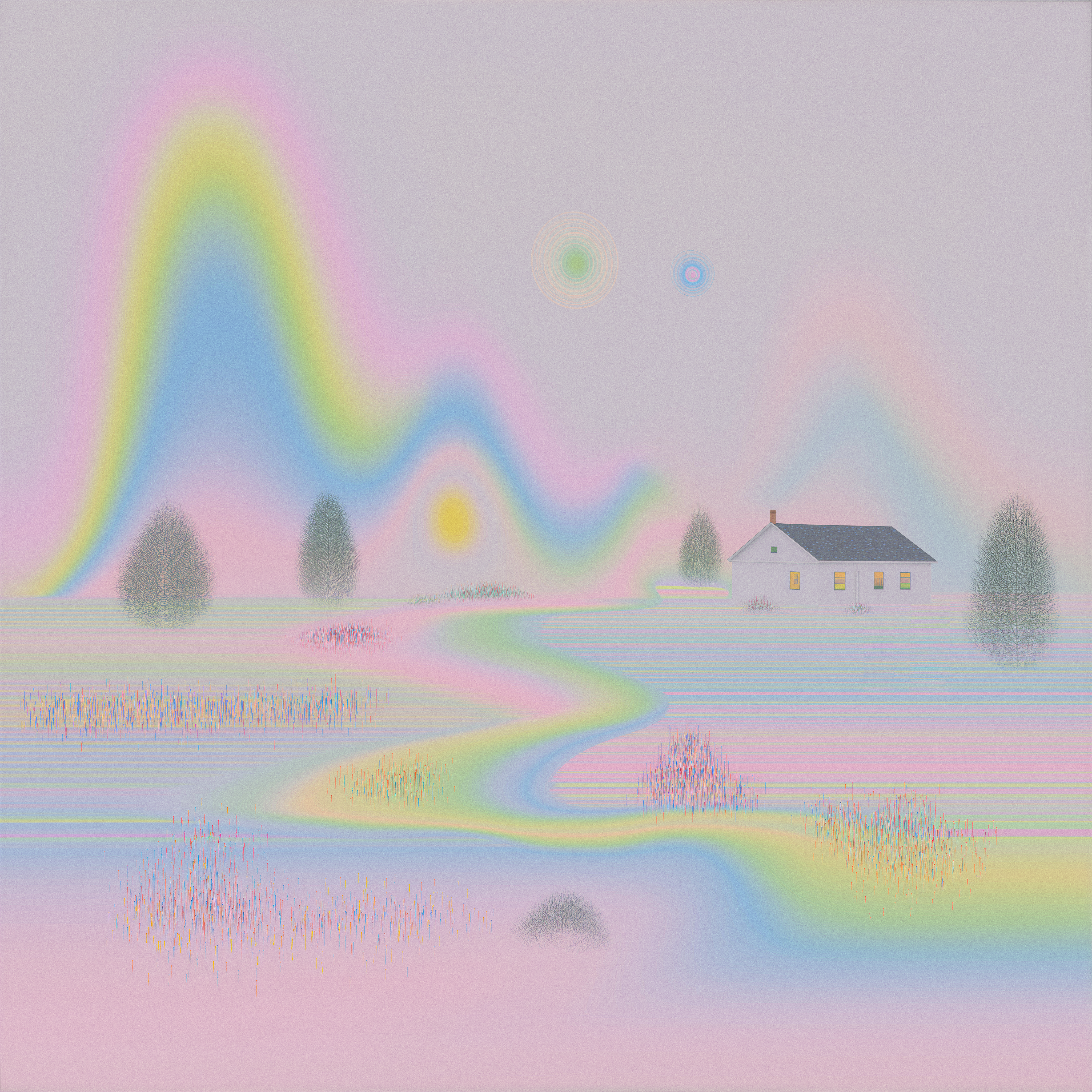
There was no return address, no signature—only a photograph of a small white house nestled against mountains that rippled like fabric dyed in pastels. A winding stream curved toward the foreground, its water catching light that seemed to come from nowhere and everywhere at once. On the back, someone had written in faded pencil: She is still waiting.
I had not thought about that house in seventeen years.
I took the train as far as it would go, then walked. The path followed the stream, which did not behave like water should. It reflected colors the sky did not contain—yellows and pinks and soft greens that pooled in its bends like spilled tea. The grass on either side grew in thin stalks, each blade a different hue, swaying without wind.
The mountains ahead were not quite mountains. They rose and fell in gentle curves, their edges soft and uncertain, as though someone had started to erase them and then changed their mind. Two small lights hung in the grey sky—one green, one blue—and I understood without knowing how that these were not suns, not moons, but something older. Witnesses, perhaps. Or memories of light that had forgotten how to leave.
I reached the house at dusk, though dusk seemed to be the only time that existed here.
She was sitting on the porch, just as she had been seventeen years ago when I left. A woman of perhaps thirty, or perhaps three hundred—it was impossible to tell. Her hair was the grey of winter fog, and her eyes held the same quality as the stream: reflecting things that were not there.
"You received my postcard," she said. It was not a question.
"I didn't know you could send mail from here."
"I can't," she said. "Someone else sent it. Someone who remembered."
I climbed the three wooden steps and sat beside her. The porch looked out over the meadow and the stream and the soft mountains beyond. From here, I could see the trees that dotted the landscape—dark shapes that might have been pines, or might have been the shadows of pines that had existed long ago.
"I forgot," I said. "For seventeen years, I forgot this place existed."
"That's how it works," she replied. "The forgetting. It's not unkind. It's protection."
"Protection from what?"
She turned to look at me, and in her eyes I saw the reflection of a young man I no longer recognized—someone I had been, once, in another version of my life.
"From remembering too well," she said. "From wanting too much to return."
That night, she made tea from leaves that grew only in the hour between light and dark. We sat at her small kitchen table while the two lights in the sky traded places slowly, the way thoughts trade places in a sleepless mind.
"The others have all gone," she told me. "The ones who used to visit. The stream took them one by one. Not violently—it never does anything violently. It simply... absorbed them. They became colors in the water. You might have seen them on your walk. The yellow was a painter who came here every autumn. The pink was a woman who lost her husband to a war that was never officially declared."
"And you?"
"I was already a color when I arrived. The house recognized me. It let me stay solid."
I wrapped my hands around the cup. The warmth felt real, at least. That was something.
"Why did you call me back?"
She was quiet for a long time. Outside, something moved through the meadow grass—not an animal, but an impression of movement, a memory of something that had once walked there.
"The house is tired," she finally said. "It has been here since before the mountains forgot their shape. It has watched the stream fill with souls. It has seen the lights in the sky dim and brighten and dim again. And now it wants to sleep."
"What happens when it sleeps?"
"Everything here will become a postcard. Flat. Still. Beautiful, but no longer breathing." She set down her cup. "I wanted someone to know it had been real. I wanted someone to remember."
I stayed for three days, or perhaps three weeks—time moved strangely, folding in on itself like origami. I walked the meadow and learned the names of the colors in the stream. I watched the pine-shadows sway in windless air. I sat on the porch with the grey-haired woman and listened to stories about people who had loved this place so much they became part of it.
On the last morning—and I knew it was the last because the house told me, in the way houses sometimes do—she handed me a small glass bottle.
"Water from the stream," she said. "One drop, and you will remember this place forever. Two drops, and you will forget you ever left."
I put the bottle in my pocket without opening it.
At the edge of the meadow, where the path began its long journey back to the world of trains and Tuesdays, I turned to look at the house one final time. It was already flattening, its edges softening like a photograph left too long in sunlight. The woman on the porch raised her hand.
I raised mine in return.
The postcard sits on my desk now, next to the unopened bottle. Some nights, when sleep refuses to come, I hold them both up to the lamp and imagine I can see movement in the still image—the stream flowing, the grass swaying, a woman waiting on a porch for someone who may or may not return.
I have not yet decided how many drops I will drink.
Perhaps that is the real magic: not the choice itself, but the long, quiet wondering.