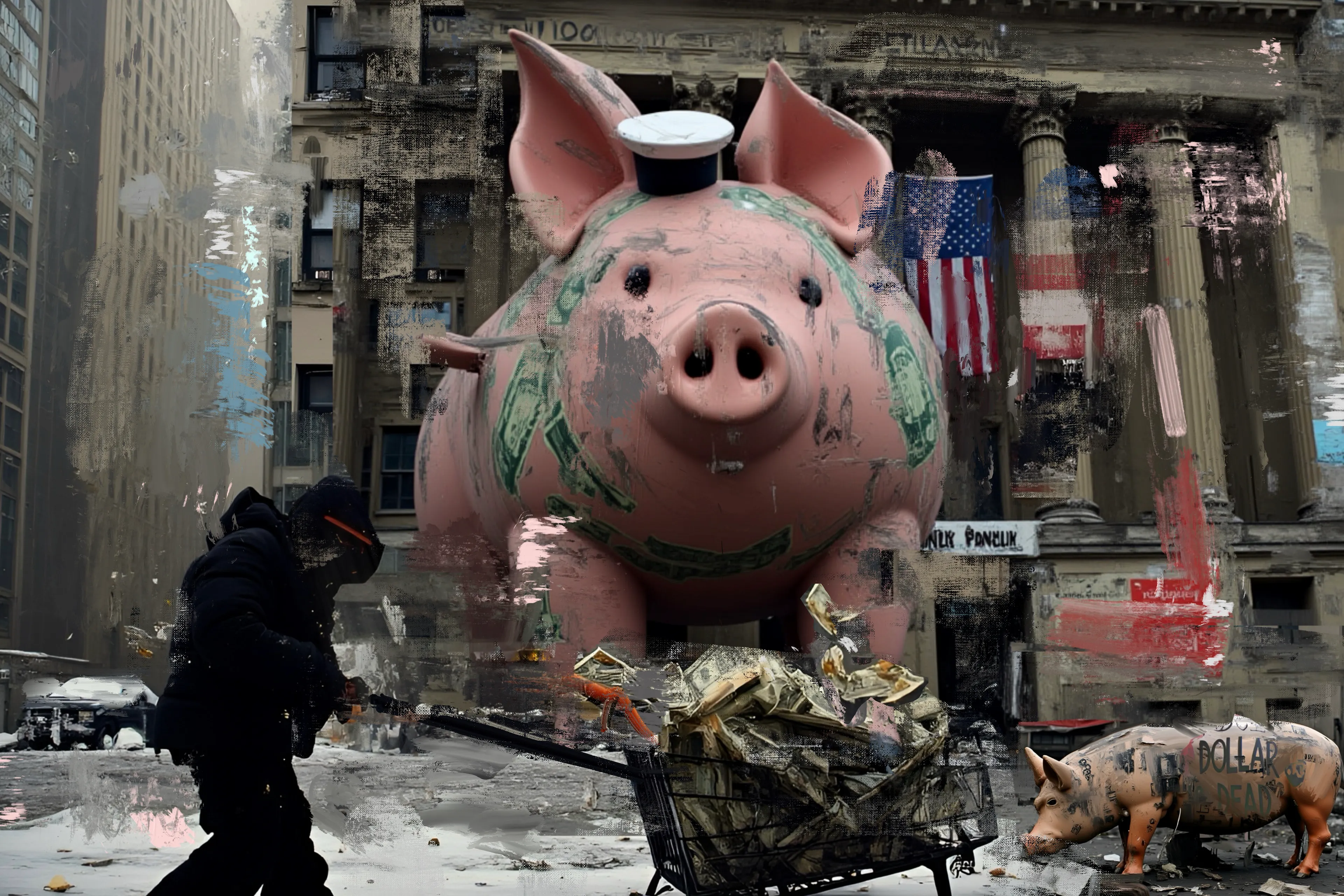
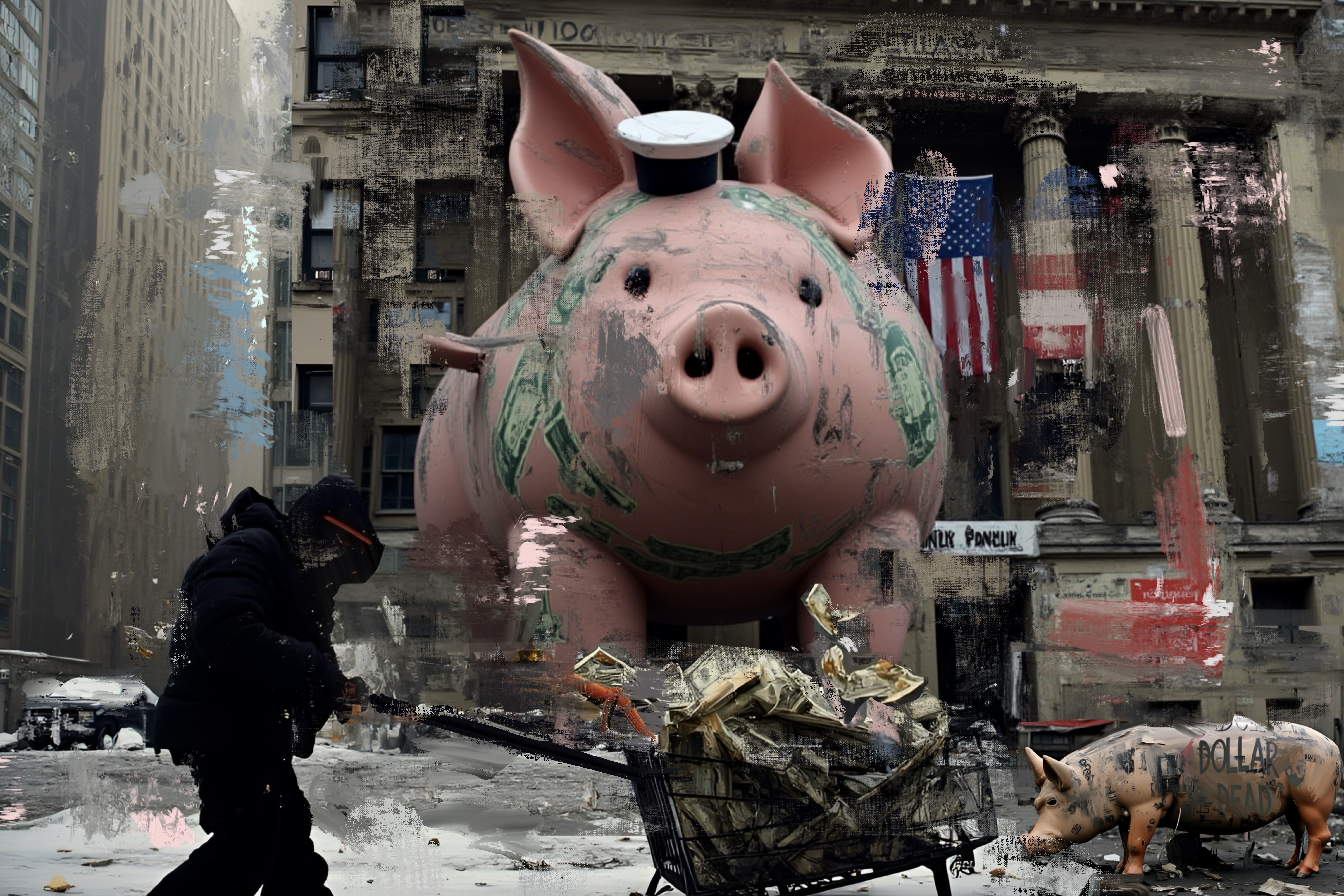
Piggy Bank confronts the viewer with a currency that has lost its function but not its dominance. The dollar appears everywhere in the painting, stacked, spilled, scaled into architecture, yet it no longer operates as value. Instead, it behaves like debris, abundant, weightless, and increasingly irrelevant.
The monumental piggy bank positioned before a decaying financial façade functions as a relic of institutional faith. It does not protect wealth, it preserves redundancy. The image suggests a system in which money continues to exist not because it works, but because there is no agreed alternative. The dollar persists as habit rather than necessity.
Below, a lone figure pushes a cart of crumpled bills through a frozen urban landscape. The gesture is tragic and absurd, labor expended on something that can no longer fulfill its role. Even the patriotic symbols read as performance, stripped of authority and clinging to a narrative misaligned with material reality.
Formally, the distressed surface and fractured composition echo this collapse of function. The painting reads less as a warning than as documentation. The crisis has already occurred, what remains is the administration of its aftermath.
Piggy Bank captures the moment when a currency becomes cultural residue, still visible, still monumental, but fundamentally redundant. Value has moved elsewhere. The dollar remains behind, enlarged into spectacle, presiding over a system sustained by inertia rather than belief.